Mini Excavator Uses and Benefits: The Complete Australian Guide to Maximize Efficiency
You’ve lost count of how many hours you’ve spent with a shovel, fighting hard, dry clay that feels like concrete. The kind that becomes rock-like in summer and requires serious effort to break through. Your back aches after 6 hours of manual trenching, your quote came in too high because you had to factor in three days of manual labour, and you just watched another landscaping job go to the bloke with a mini excavator who quoted half your time. Meanwhile, that pool excavation in a tight Baulkham Hills backyard? You couldn’t even bid on it because there’s no way to get standard earthmoving equipment through the customer’s 850mm side gate.
This guide covers everything Australian tradies and contractors need to know about mini excavators: the specific applications that make compact machines invaluable on residential sites, real productivity numbers (not marketing fluff), which attachments match which jobs, transport trailer requirements for towing with your ute, and honest guidance on whether buying, hiring, or financing makes sense for your situation. No filler, no generic advice from American websites with pounds and feet instead of kilos and metres.
Note: Pricing, specifications, and regulations referenced in this guide reflect NSW market conditions and may change. Always verify current figures with suppliers and relevant authorities before making decisions.
Mini excavators have changed how Australian landscapers, builders, and excavation contractors approach residential projects across New South Wales. The ability to squeeze through a standard 900mm gate, work on finished driveways without damage, and deliver serious digging power in a compact package makes the tracked mini excavator the most versatile earthmoving equipment for small-to-medium jobs. If you’re doing residential work without one, you’re working harder than you need to. And probably losing money to competitors who’ve made the switch.
Power Your Business with STM Trucks & Machinery
Whatever the size of your business, our experienced sales team will help you get the best from your budget.
What Is a Mini Excavator? Understanding Compact Excavation Equipment
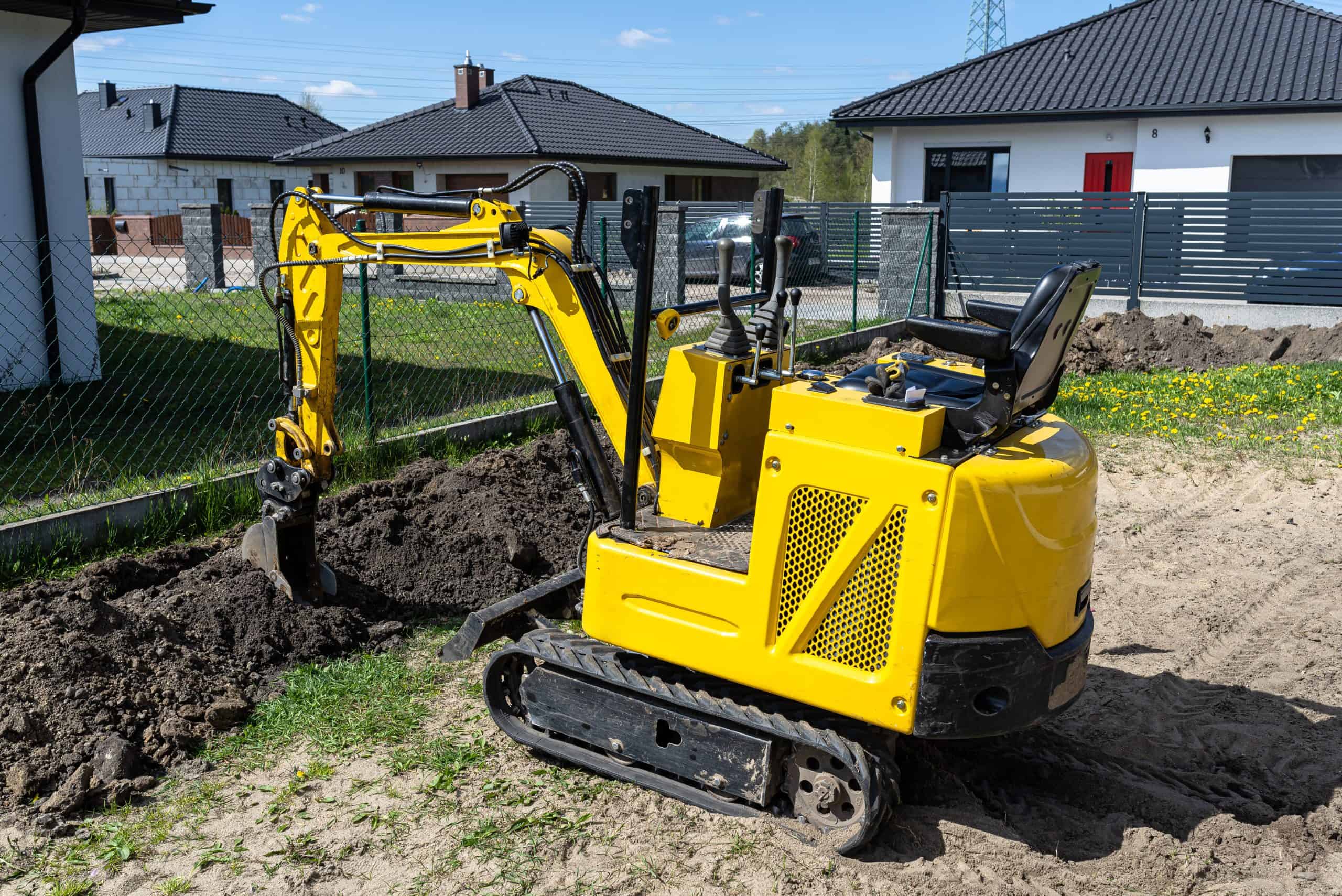
A mini excavator is a compact, tracked earthmoving machine with an operating weight under 10 tonnes, designed for precision excavation in confined spaces. Also called compact excavators, mini diggers, or small excavators, these versatile machines feature a rotating cab, boom and arm assembly, and interchangeable attachments for digging, trenching, demolition, and material handling applications on residential and commercial sites.
The key distinction between mini excavators and larger standard excavators comes down to access. These machines reach sites that standard earthmoving equipment cannot, including backyards through residential gates and established gardens where surface protection matters.
Key Components of a Mini Excavator
Every mini excavator shares the same basic anatomy, and understanding these components helps when comparing machines or discussing specifications with dealers.
The undercarriage (the tracked base that contacts the ground) sits at the bottom. Most residential machines come with rubber tracks, though steel tracks are available for rougher conditions. Rubber tracks matter for landscaping contractors because rubber track systems won’t destroy driveways, footpaths, or established lawns the way steel tracks do. Replacing turf damaged by steel tracks can cost homeowners significant money per square metre. That surface damage becomes your reputation on the line.
Above the undercarriage, the cab (operator compartment with controls and seat) sits on a slewing ring (the rotating bearing assembly allowing 360-degree movement). The boom (the main hydraulic arm extending from the cab) connects to the arm, also called the stick, which holds your attachment. Most mini excavators also include a dozer blade at the front for backfilling and rough levelling.
What is zero tail swing on a mini excavator?
Zero tail swing design (ZTS) keeps the counterweight within the track width during cab rotation, allowing the mini excavator to work safely within 150mm of fences, buildings, and obstacles. On conventional excavators, the counterweight swings 300-500mm beyond the track width during rotation. A zero-tail-swing mini excavator eliminates this overhang problem. Essential for tight-access landscaping where hitting a customer’s fence means expensive repairs and a Google review you don’t want.
Understanding Weight Classes and What They Mean for Your Work
Mini excavator weight classes in Australia break down into four categories, each suited to different applications and transport arrangements.
1-2 tonne class mini excavators serve as the access kings for tight residential sites. These compact machines measure 990-1,100mm wide and fit through standard 900mm residential gates when tracks are retracted. The Kobelco SK17SR offers a track-retracted width of 990mm specifically for gate access. These suit landscaping, trenches under 1.5m deep, and one-person operations where you’re loading solo. Digging depth maxes out around 2.2-2.4 metres, depending on the model variant.
2-4 tonne class mini excavators represent the sweet spot for most landscapers and residential contractors. This weight class provides enough digging depth (2.8-3.5 metres) and breakout force (15-25 kN) for pool excavation, serious trenching, and retaining wall prep. Transport remains manageable on a 3,500kg-rated trailer behind a 4WD ute.
4-6 tonne class compact excavators step into light commercial territory with greater dig depth (3.5-4.2 metres), more lifting capacity (1,500-2,500kg at 3m reach), and faster cycle times. At this size, you’re entering midi excavator territory. Transport requires a dedicated plant trailer rated 6,000kg+ or delivery.
6-10 tonne class excavators sit at the upper edge of “mini” classification. Most operators arrange delivery rather than self-transport at this size.
The weight class you need depends entirely on your typical jobs. We’ll cover sizing decisions in detail in the selection guide section below.
Common Mini Excavator Uses: Applications for Australian Projects
Mini excavators handle an enormous range of earthmoving tasks on residential and light commercial sites, from pool excavation to utility trenching to light demolition.
Look, you can dig a hole with a shovel. You can also drive a nail with a rock. The question isn’t whether manual methods work. It’s whether manual excavation is the smart choice when a shovel moves 0.5 cubic metres per hour, while a 1.7-tonne mini excavator moves 8-12 cubic metres per hour.
Landscaping and Garden Transformation
Landscaping is where mini excavators earn their keep for many Australian operators who own or regularly hire compact excavation equipment. The productivity difference between machine excavation and hand-digging transforms the profitability of landscaping projects.
Retaining wall construction demands precise trench excavation. You need 300mm wide by 300mm deep for block walls under 1 metre, or 450mm x 450mm for walls up to 1.5 metres. A mini excavator cuts clean, consistent trenches at 15-25 linear metres per hour versus 3-5 metres per hour by hand. Garden transformations involving 20-40 cubic metres of soil movement go from 3-4 day projects to single-day completions with a competent operator.
Drainage installation becomes genuinely viable when you can trench efficiently. Installing an AG pipe, stormwater connections, and French drains requires trenching 300-400mm wide and 300-600mm deep. That’s backbreaking by hand. With a trenching bucket on a mini excavator, the same job takes a fraction of the time.
How long does it take to excavate a pool with a mini excavator?
Pool excavation for a standard 8m x 4m fibreglass pool (approximately 50 cubic metres) typically takes a 2-4 tonne mini excavator 4-6 hours with a competent operator. Manual excavation can require 20-30 labour hours with a 3-person crew. The productivity difference makes machine-assisted pool excavation the practical approach for Australian pool builders. Individual results vary based on soil conditions and operator experience.
Residential Building and Renovation Work
Builders and renovation contractors find mini excavators essential for footings excavation and site preparation on residential blocks.
Strip footings for extensions need trenches 450mm wide by 300-500mm deep, depending on engineering requirements. Pier holes for decks require 450-600mm diameter holes at 2-3 metre centres. Trenching for services (electrical at 500mm depth, plumbing at 300-450mm, gas at a minimum 300mm cover) all fall in the mini excavator’s wheelhouse.
Site preparation tasks like removing 50-100mm of topsoil across 400-600 square metres, rough levelling, and clearing vegetation get done in 4-6 hours rather than 2-3 days with manual labour. For knockdown-rebuild projects, compact excavators handle site clearing after demolition within a single day rather than a week.
Utility and Service Installation
The NBN rollout created massive demand for mini excavator work, with millions of premises connected since 2010, each requiring conduit trenching.
Conduit installation for telecommunications (50mm HDPE pipe at 300mm depth), power (minimum 500mm cover), and gas connections (minimum 300mm cover) requires precise trenching that mini excavators handle at 20-35 linear metres per hour in average soil. This productivity makes utility installation viable as a core business for excavation contractors.
Stormwater installation involves trenching at specific grades. Council typically requires a minimum fall of 1:100 for 90mm pipes and 1:80 for 100mm pipes. Check your local council’s requirements, as they can vary. Mini excavators allow operators to work methodically without exhaustion, compromising accuracy by hour six.
Light Demolition and Site Clearing
Shed removal is surprisingly common. A mini excavator with a hydraulic thumb pulls apart old sheds in 2-3 hours, breaks up concrete slabs up to 100mm thick, and loads debris much faster than manual demolition.
Concrete breaking with a hydraulic breaker attachment turns a mini excavator into a demolition tool for driveways (100mm thick), paths (75-100mm), and small structures. For residential-scale concrete removal up to 30 square metres, compact excavators often represent the practical approach.
Bush block clearing suits mini excavators well for removing scrub, small trees up to 200mm trunk diameter, and stumps to 400mm. The machine pulls stumps in 5-15 minutes each versus 45-60 minutes manual. Rural property owners use mini excavators for dam cleaning, fence line preparation, and land management.
Key Benefits of Mini Excavators: Why Tradies Choose Compact Equipment
Australian landscapers, builders, and contractors choose mini excavators for six core benefits:
- Access tight spaces through standard 900mm gates that exclude larger excavators
- Protect finished surfaces with rubber tracks exerting low ground pressure (25-35 kPa)
- Transport easily on tandem trailers behind standard utes with 3,000kg+ towing capacity
- Complete excavation is significantly faster than manual digging
- Reduce labour costs compared to manual crews
- Handle multiple tasks with interchangeable attachments, including buckets, augers, and breakers
Productivity gains are dramatic and measurable. A 1.7-tonne excavator digs a standard pool shell (50 cubic metres) in 4-6 hours, versus 20-30 labour hours by hand. For trenching, you’re looking at 15-25 linear metres per hour, versus 3-5 linear metres per hour hand-digging. In real conditions, that’s often 5-8 times faster.
Why such a dramatic productivity difference? Hydraulic excavation concentrates 15-25 kN (1,500-2,500kg of force) through a bucket edge. Your arms through a shovel generate maybe 150-200N. That’s roughly 100 times the mechanical advantage before factoring in the machine’s tireless consistency versus human fatigue after hour two.
Access advantage matters more than most operators initially realise. Residential side gates commonly measure 900-1,200mm wide. A 1-2 tonne mini excavator with retractable tracks fits through with 50-100mm to spare. You’re not relying on crane access or removing fence sections. You drive straight in.
Rubber tracks protect finished surfaces. Surface protection sounds minor until you’ve quoted thousands for turf replacement after damaging a lawn. Rubber tracks distribute weight at 25-35 kPa, compared with 45-60 kPa for steel tracks. For context, human footsteps exert about 50 kPa of force. Rubber-tracked minis work on established lawns, exposed aggregate driveways, and paved areas without damage.
Transport practicality changes your operating model. A 1.7-tonne excavator on a tandem trailer behind a ute with 3,000kg+ towing means you control logistics entirely. No waiting for float trucks, no delivery fees eating into margins.
Running costs stay manageable. Fuel consumption for mini excavators varies by size: micro excavators (under 1 tonne) use 1-2 litres per hour, 1.5-tonne machines typically consume 3-4 litres per hour, and 3-tonne excavators use 4-5 litres per hour. At current diesel prices, that’s typically a few dollars per hour depending on machine size. Maintenance is simpler than for larger machines.
Versatility through attachments multiplies value. One machine accepts buckets, augers, hydraulic breakers, and grabs. Instead of buying different equipment, you buy or hire attachments and adapt.
Actually, quick sidebar on labour costs that most tradies get wrong: Two labourers working two days on a pool dig costs a significant amount in wages before workers comp, before the fact that those workers could earn profit elsewhere. A mini excavator hire is a fraction of that cost. You finish by lunch, bill the customer the same amount, and have your crew earn on another site. The comparison isn’t close once you run real numbers instead of just looking at the hire invoice.
Mini Excavator vs Standard Excavator: Choosing the Right Size
This comparison isn’t about mini excavators being ‘better.’ It’s about matching equipment to job requirements. Both machine categories exist because different jobs demand different capabilities. For a deeper breakdown, see our detailed guide on mini excavators vs larger models for NSW tradies and landscapers.
| Factor | Mini Excavator (Under 10T) | Standard Excavator (10T+) |
| Operating Weight | 1-10 tonnes | 10-90+ tonnes |
| Typical Dig Depth | 1.5-4.5 metres | 4-10+ metres |
| Transport | Trailer/self-transport is viable | Float required |
| Minimum Access Width | From 990mm | 2,400mm minimum |
| Fuel Consumption | 1-8 litres/hour | 8-25 litres/hour |
Choose a mini excavator when: you’re on residential sites, need gate access under 1,200mm, want to protect finished surfaces, handle your own transport, or dig to a depth of 3-4 metres. Pool excavation (2.0-2.5m depth), landscaping, service trenching, and residential construction typically fall into mini excavator territory.
Choose a standard excavator when: You’re excavating over 4 metres deep, moving over 200 cubic metres daily, working on open sites with 3+ metre access, or need reach beyond 5-6 metres.
Here’s an unpopular opinion among machinery dealers: Many landscapers don’t need anything bigger than a 3-tonne machine for the majority of their work. The tendency to upsize “just in case” can cost an extra couple of hundred dollars per day in hire rates without delivering proportional benefits. Start with what fits your typical jobs. Measure your most common gate widths, not your occasional outliers that happen twice a year.
Essential Mini Excavator Attachments and Their Applications
The base machine is just the platform. Attachments determine what you accomplish, and the right selection can replace the need for separate equipment.
Digging Buckets: Choosing the Right Profile
GP (General Purpose) buckets handle the majority of digging tasks. Available in widths of 300-600mm. If buying one bucket, choose a 450mm GP. It suits most residential work.
Trenching buckets (150-300mm wide) cut service trenches efficiently. Width matches pipe requirements. 200mm for NBN conduit, 300mm for stormwater. For utility work, a trenching bucket pays for itself quickly through improved finish quality.
Mud buckets (450-900mm) lack teeth for cleaning up, final grading, and handling saturated clay that clogs toothed buckets.
For most operators, a 450mm GP and 250mm trenching bucket covers typical requirements.
Augers for Post Holes and Drilling
Auger attachments turn a mini excavator into a drilling machine, driving through soil at 200-400mm per minute versus 10-15 minutes per hole with a handheld digger. In hard clay, the difference is even more pronounced.
Common sizes: 200-250mm for standard fence posts, 300mm for deck piers, 450mm+ for substantial foundations.
Auger attachments typically run a few thousand dollars, including planetary drive from suppliers like Digga, Auger Torque, or Groundhog. Hire is available for occasional use.
For hard clay soils (common in Blacktown, Bringelly, and Luddenham areas), you’ll often need pilot boring or clay-specific auger designs with aggressive cutting faces.
Breakers, Rippers, and Demolition Attachments
Hydraulic breakers deliver 200-800 blows per minute for concrete demolition. Sizing matters: a breaker needs 20-40% of the excavator’s hydraulic flow. A 1.7-tonne producing 40 L/min suits a breaker requiring 25-35 L/min.
Quality brands (Rammer, Indeco, Kent) break 100mm concrete at 3-5 square metres per hour. Budget brands? Often half that productivity, twice the maintenance headaches.
Ripper attachments break compacted ground and remove roots. On compacted clay, a ripper pass can significantly improve productivity.
Hydraulic thumbs grip irregular objects, including logs up to 300mm in diameter, rocks up to 200kg, and demolition debris. Eliminates much of the manual handling.
Tilt buckets add a 45-degree rotation for grading at angles. Essential for battering banks and drainage work where fall matters.
How Much Does a Mini Excavator Cost? Buying, Hiring, and Finance Options
The following figures provide general guidance based on NSW market conditions. Always verify current pricing with suppliers, as costs change regularly.
How much does it cost to buy a mini excavator in Australia?
New mini excavators typically range from around $35,000 for entry-level 1-tonne machines to $140,000+ for 6-tonne compact excavators:
- 1-2 tonne: Generally $35,000-55,000
- 2-4 tonne: Generally $55,000-95,000
- 4-6 tonne: Generally $85,000-140,000
- Prices typically exclude GST
Used prices depend on hours and condition. Machines with 2,000-4,000 hours and documented service history typically sell for 40-60% of new. Over 5,000 hours drops to 30-45% and requires careful inspection.
NSW hire rates (indicative, verify current pricing):
- 1.7T daily dry hire: Around $280-380
- 1.7T weekly: Around $950-1,400
- 3.5T daily: Around $350-500
- 3.5T weekly: Around $1,200-1,800
Wet hire (including operator) typically runs around $120-180/hour with minimum engagement requirements.
The buy-versus-hire calculation comes down to utilisation. Over 80-100 days annually, ownership often makes sense. For under 40 days annually, the hire may keep the capital free for other uses. Our mini excavator buying guide Australia walks through the full breakeven formula with real numbers to help you decide.
Finance options:
A chattel mortgage leaves you owning the asset while making payments over 3-5 years. Interest may be tax-deductible, and you can claim depreciation. Consult your accountant for advice specific to your situation.
Finance lease means the finance company owns the equipment. Monthly payments may be fully tax-deductible as operating expenses. Again, verify with your accountant.
Hire purchase functions similarly to a chattel mortgage, with ownership transferring at the end of the term.
Dealers like STM Trucks & Machinery typically offer finance approval within 24-48 hours for established businesses with standard documentation.
Hidden ownership costs (annual, indicative for 1.7T machine):
- Insurance: Varies significantly by provider and coverage
- Maintenance: Often 5-8% of machine value annually
- Trailer: Purchase or delivery costs
- Storage: Monthly costs if lacking secure yard space
Transporting a Mini Excavator: Trailer Requirements and Logistics
Transport logistics trip up many first-time excavator buyers who don’t think through requirements before purchasing.
Trailer capacity must exceed the machine weight by a margin. A 1.7-tonne excavator needs a trailer rated for at least 2,500kg ATM, covering the machine, 150-200kg attachments, fuel, and trailer weight. ATM ratings are legal maximums, not operating targets.
Tandem plant trailers suitable for 1.7-2T excavators are available from various manufacturers. Used trailers in good condition can offer value.
Towing-vehicle requirements scale with the total weight. A 1.7-tonne excavator on an 800kg trailer with 100kg attachments equals 2,600kg before fuel. Most dual-cab utes (Hilux, Ranger, BT-50) tow 3,100-3,500kg braked, handling excavators up to about 2 tonnes. Above that, you’re looking at a Land Cruiser 300 Series or light truck.
How do you safely load a mini excavator onto a trailer?
Loading takes 5-10 minutes once you’ve done it a few times. First-timers should budget 20-30 minutes and have someone to guide them. The cab view makes depth perception tricky on narrow ramps. Drive up slowly in low range, keep the boom low and centred, never correct mid-ramp. Back off, realign, restart.
Tie-downs must be rated for machine weight. Use a minimum of 2,500kg WLL per tie-down for a 1.7T using four points. Unsecured excavators have killed operators during transport. Proper tie-down is essential, not optional. For the full rundown on compliance and best practices, read our guide on how to transport a mini excavator safely.
When self-transport stops making sense:
- Machine weight exceeds towing capacity
- Job distance exceeds 60-80km one-way
- Insurance excludes claims during transit
- No loading facilities at the site
What Size Mini Excavator Do I Need? A Practical Selection Guide
Matching size to job requirements saves money in unnecessary hiring costs and prevents the frustration of bringing the wrong tool.
1-2 tonne class suits:
- Backyard landscaping through 900mm gates
- Trenching to 1.5-2.2m depth
- One-person operations loading solo
- Operators with 2,000-2,500kg trailers and 3,000-3,500kg towing
The Kobelco SK17SR: approximately 1,650-1,790kg operating weight (varies by model variant), zero tail swing, 2.2m dig depth, retracts to 990mm for gate access.
2-4 tonne class suits:
- Pool excavation (suitable for most fibreglass pools requiring 2.0-2.5m depth)
- Landscaping moving 40-100 cubic metres
- Residential construction across 300-800 square metre blocks
- Jobs requiring 3.0-3.5m dig depth
Kobelco SK30SR (3,150kg, 2,960mm depth) and SK35SR (3,550kg, 3,340mm depth, 22.5 kN breakout force).
4-6 tonne class suits:
- Larger sites with 1,500mm+ access
- Commercial prep and car park excavation
- Dig depth to 4.0-4.5 metres
Decision factors beyond weight:
Gate width: Measure your 10 most common access points. Many residential side gates measure 900-1,200mm. A machine that won’t fit forces crane access or fence removal.
Ground conditions: Hard clay requires 20-30% more breakout force than sandy coastal soils. If working in Baulkham Hills, Kellyville, Castle Hill clay, don’t undersize. A 1.7T struggles where a 3.5T works efficiently.
Dig depth: Check specs carefully. Depth varies between 300 and 500mm within weight classes. A pool requiring 2.4m eliminates most 1.7T machines (2.2-2.3m typical maximum).
Do You Need a License to Operate a Mini Excavator in Australia?
In NSW, you do not need a specific licence to operate a mini excavator under 5 tonnes operating weight. However, SafeWork NSW requires operators to demonstrate competency through appropriate training. Excavators are not listed under high-risk work licences, but employers must still ensure operators are trained and competent. Employers must ensure operators are trained and competent before using excavation equipment. Penalties apply for non-compliance. Regulations change, so verify current requirements with SafeWork NSW.
This “no licence required” rule confuses people because it sounds like anyone can jump on a mini excavator. Technically, yes. There’s no earthmoving licence under 5 tonnes like there is for forklifts. Practically, operating without competency puts you and others at risk.
Training options:
Formal courses (1-2 days) cover machine familiarisation, safe operation, hazard identification, and practical time. You receive a Statement of Attainment (nationally recognised RII training package credential). Providers include TAFE NSW and Civil Safety. Insurers often deny claims involving untrained operators.
Dealer training is included with most purchases at no cost.
Insurance implications: Most policies require appropriate competency. An incident with an untrained operator can void coverage entirely. That’s potentially tens of thousands of dollars in uninsured costs. Training is worth the investment.
Employer responsibilities: SafeWork NSW places competency responsibility directly on the PCBU. Documentation matters. Keep copies of Statements of Attainment, induction records, and competency assessments.
For excavators over 5 tonnes, national High Risk Work Licence requirements apply, and certification becomes mandatory.
When NOT to Use a Mini Excavator: Understanding Limitations
This section doesn’t appear in competitor articles, but it should. Knowing when the tool doesn’t fit prevents costly mistakes and protects your reputation.
Excavation depth beyond machine capability catches many first-time hirers. A 1.7-tonne maxes out around 2.2-2.3 metres. Planning a basement (2.7-3.0m)? You need a 3.5T+ minimum.
Very soft or boggy ground (bearing capacity under 50 kPa) defeats rubber-tracked minis. Ground pressure for a 1.7T runs 25-35 kPa. Fine for most conditions, but saturated clay can drop below 20 kPa. Wet sites may need 2-4 weeks of drainage before excavator use becomes viable.
Heavy rock slows mini excavators to 10-20% of normal productivity. Production rates in sandstone (2-4 square metres per hour) bear no resemblance to rates in soil (15-25 cubic metres per hour). For significant rock excavation exceeding 10 cubic metres, larger equipment is required.
Jobs requiring significant reach expose limitations. Arm reach maxes around 4.5-5.5 metres. Standard 13-20T excavators offer 8-10m reach.
High-volume earthmoving doesn’t suit compact equipment. It’s math, not opinion. Moving 500 cubic metres at 10-15 cubic metres per hour means 35-50 hours of operation. A 13-tonne excavator moves 40-60 cubic metres per hour, completing the same in 8-12 hours.
Being honest about limitations builds trust and helps price jobs accurately.
Why Choose Kobelco Mini Excavators? Quality, Fuel Efficiency, and Reliability
Kobelco has built excavators since 1930. That’s 90+ years of dedicated manufacturing, not a sideline from agricultural equipment. Japanese manufacturing with a single-minded excavator focus means engineering prioritises what matters: hydraulic efficiency, structural durability, and operator comfort during 8-10 hour days.
Fuel efficiency distinguishes Kobelco. The company reports achieving significant reductions in fuel consumption over the past decade through continuous development of low-fuel-consumption functions. The iNDr (Integrated Noise and Dust Reduction) cooling system centralises the radiator, oil cooler, and air cleaner in a sealed compartment, reducing engine noise compared to conventional systems. The system pulls air through an enclosed engine in a pattern designed to muffle noise. Quieter operations matter where neighbours can hear the difference between “tolerable” and “complaint to council.”
Zero tail-swing models (SR series, including SK17SR, SK30SR, SK35SR) deliver genuine compact operation. The counterweight tucks inside the track width during rotation, enabling work close to obstacles. For landscapers, zero tail swing is essential for accessing residential backyards without damage.
Durability under Australian conditions shows as Kobelco machines accumulate thousands of hours across NSW. Sealed components for dust protection, robust undercarriage design, and hardened bucket pins handle coastal sand to western clay.
Power Your Business with STM Trucks & Machinery
Whatever the size of your business, our experienced sales team will help you get the best from your budget.
Conclusion
Mini excavators deliver genuine productivity multipliers for Australian landscapers, builders, and contractors on residential and tight-access sites. Compact dimensions (under 1,000mm gate access for 1-2T machines with tracks retracted), surface-friendly rubber tracks, and attachment versatility make them indispensable where standard excavators cannot operate.
Before committing to purchase, hire, or finance, run the numbers honestly. Count annual utilisation days (break-even sits around 80-100 for ownership versus hire, though this varies by situation). Measure your typical access points. Don’t guess. Use a tape measure on your 10 most common gates. Check whether your vehicle handles towing requirements. Decide which 2-3 attachments match your regular jobs before buying.
Note: All pricing, specifications, and regulatory information in this guide reflect conditions at the time of writing and will change. Verify current figures with suppliers, check regulations with SafeWork NSW, and consult qualified professionals for financial and legal advice specific to your situation.
STM Trucks & Machinery stocks Kobelco mini excavators from 1.7T to 10T. Visit showrooms in Smeaton Grange, Queanbeyan, or Unanderra to discuss what suits your operation. Alternatively, call (02) 4647 4488 for straightforward advice on sizing, attachments, and transport.