Construction Trucks Australia: How to Choose the Right Truck for Your Building Project
You’re standing in a dealer lot, looking at a row of construction trucks that all claim to be “perfect for building sites,” and you have no idea which one won’t become an $80,000-$150,000 mistake. The salesperson is talking about GVM ratings and axle configurations, and your mate reckons you should buy whatever he bought three years ago. You’re quietly panicking about whether you even have the right licence to drive half these things. Meanwhile, every week you don’t decide is another week hiring trucks at $450-$800 per day and watching your margins disappear.
This guide gives you everything you need to make that decision with confidence. We’ll cover every type of truck used on Australian building sites, break down exactly which licence you need for each class, explain GVM compliance in plain English, and give you a practical framework for matching the right truck to your actual work. This isn’t generic truck information. It’s specific guidance built from decades of helping NSW builders, landscapers, earthmovers, and civil contractors choose trucks that earn their keep.
Getting your truck choice right matters more now than ever. Chain of Responsibility laws mean compliance isn’t optional, with fines starting at $10,000 and climbing to $50,000+ for serious breaches. Downtime runs $1,500-$3,000 per day in lost productivity. For most small-to-medium construction businesses, the truck is the single biggest equipment investment. Get it wrong, and you’re stuck with a vehicle that requires a licence you don’t have, or costs an extra $8,000-$15,000 annually in fuel and maintenance. Get it right, and you’ve got a workhorse that pays for itself within 18-24 months.
Note: Prices and costs mentioned throughout this guide are indicative ranges based on market conditions at the time of writing. Verify current pricing with suppliers and regulatory bodies, as costs vary by location, supplier, and market conditions.
Power Your Business with STM Trucks & Machinery
Whatever the size of your business, our experienced sales team will help you get the best from your budget.
Types of Construction Trucks Used on Australian Building Sites
Construction sites rely on specific truck categories designed for building work rather than general freight. Forget road trains and long-haul prime movers. On building sites, you’ll see a focused lineup of vehicles designed for specific tasks.
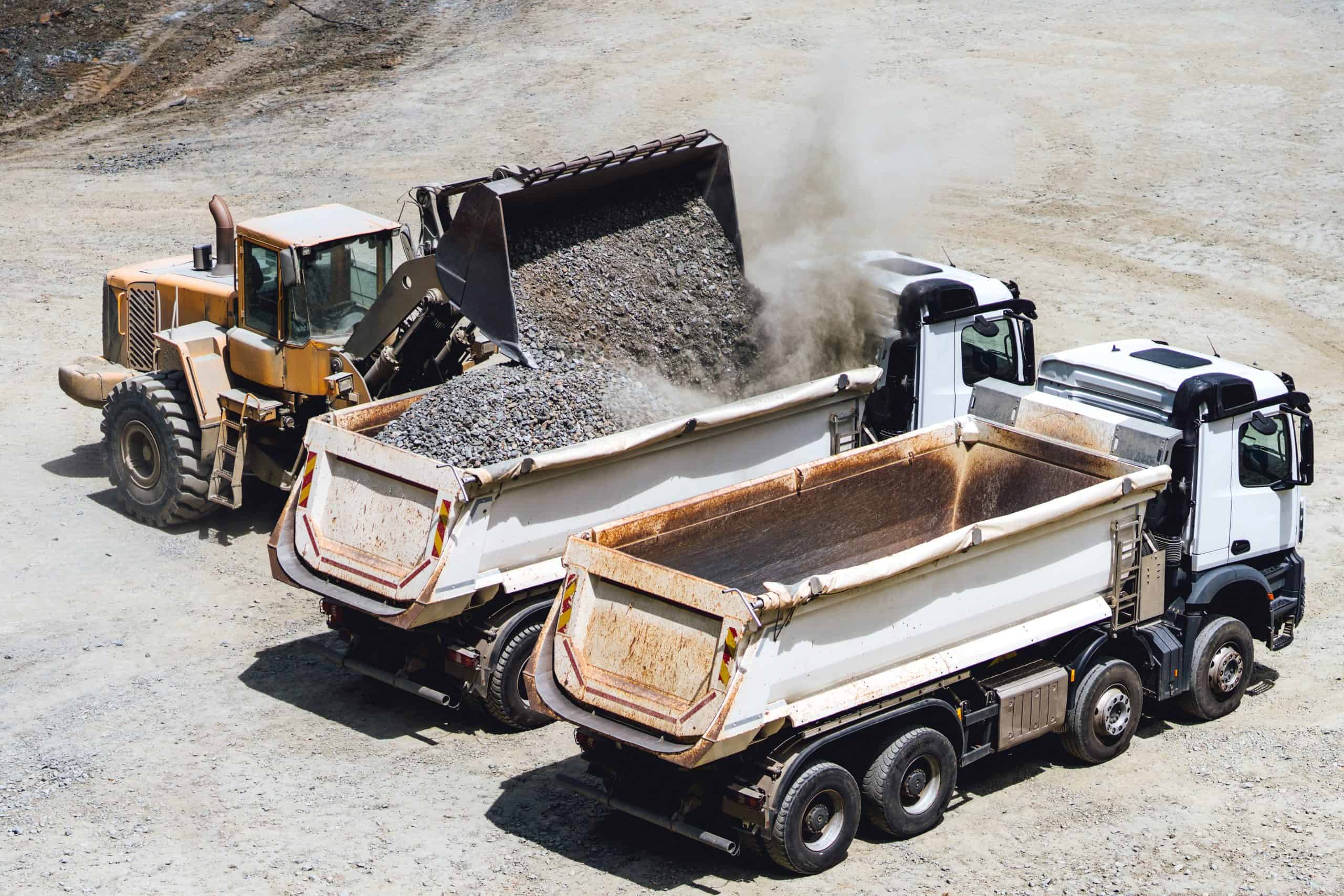
Tipper trucks remain the workhorses of Australian construction sites, designed to transport and dump loose materials such as sand, gravel, soil, and demolition waste. These hydraulic-tipping vehicles dominate everything from $5,000 landscaping jobs to $2 million civil projects because they solve the most common construction problem: moving bulk materials efficiently. A single 10-tonne tipper replaces 400+ wheelbarrow loads per delivery.
Rigid trucks, in which the cabin and tray are permanently connected to a single frame, handle a wide range of jobs. These trucks carry palletised goods, equipment, building supplies, and other items that don’t need tipping. Rigid tray trucks are your Swiss Army knife vehicles when you need to move diverse loads rather than just aggregate.
Specialist vehicles like crane trucks (typically $180,000-$350,000 new), concrete agitators (typically $250,000-$400,000 new), and water trucks (typically $120,000-$200,000 new) aren’t your first purchase. They’re what you add once operations scale up or you win contracts requiring specific capabilities.
Which construction truck should you buy first? Start with a tipper or rigid tray truck. The vast majority of construction businesses make one of these their first purchase. Tippers suit materials transport and earthmoving. Rigid tray trucks suit the transport of a variety of cargo and equipment.
Tipper Trucks for Construction: When and Why You Need One
If your work involves moving materials in any volume, and most building work does, you’re looking at a tipper. These trucks are built around one principle: load, drive, tip, repeat. The hydraulic tipping mechanism, a ram that lifts the truck body to roughly 50 degrees, dumps loads in 15-30 seconds. That means no manual unloading and fast turnaround.
Matching Tipper Size to Your Typical Loads
Here’s where most buyers stuff up: they buy based on body size rather than actual load requirements. A tipper’s useful capacity is measured in cubic metres (body volume) and payload capacity (weight you can legally carry). A 6-cubic-metre body sounds brilliant until you realise wet sand weighs 1.9-2.1 tonnes per cubic metre, dense enough to hit your weight limit long before the body is full.
Fuso, the commercial vehicle brand from Mitsubishi that has earned a loyal following among Australian tradies, produces the Canter 815 (typically $65,000-$85,000 new), which handles 4-5 tonne payloads and is ideal for residential landscaping. The Fighter 1124 (typically $95,000-$130,000 new) steps up to 7-8 tonne payloads for more demanding work.
Iveco, the Italian truck manufacturer with a strong Australian presence, offers everything from light-duty Daily models (typically $55,000-$75,000 new) through to heavy-duty Eurocargo and ACCO rigid trucks (typically $120,000-$200,000 new). This means you can stick with one brand as your operation grows.
How do I calculate what tipper size I need? Work backwards from your loads in kilograms, not cubic metres. Weigh 5-10 representative loads at a weighbridge, typically $15-$25 per weigh. Residential landscaping running 3-6 loads daily at 2-4 cubic metres each needs a 4-6 cubic metre tipper. Civil earthmoving running 8-12 loads daily needs 10+ cubic metres and higher GVM ratings.
Single-axle vs Tandem Tippers
Single-axle tippers with 4-8 tonne GVM are typically $15,000-$30,000 cheaper than comparable tandem models. They burn around 15-20% less fuel and need lower licence classes. Tandem tippers with 12-25 tonne GVM carry 40-60% more but cost more upfront, use 35-50 litres per 100km versus 25-35 for singles, and require a Heavy Rigid licence.
Honest take: if you’re starting out or doing mostly residential work, don’t overbuy. A well-specced Fuso Canter at around $75,000 that you can legally drive beats a $140,000 tandem sitting idle because your only HR-licensed driver called in sick. Upgrade in 2-3 years once you’ve got the licence, pipeline, and cash flow.
Rigid Trucks vs Articulated: Which Suits Construction Work?
Rigid trucks feature a fixed chassis where the cabin and tray form a single unit, making them more manoeuvrable than articulated combinations. The difference between a 7.5-metre turning circle and a 12-metre turning circle is the difference between getting into a residential site and not getting in at all.
Articulated trucks use a prime mover to pull a separate semi-trailer via a fifth wheel coupling. These carry 25-45 tonnes efficiently over long distances. But for construction? Their turning circles are a minimum of 11-14 metres. Reversing takes 200+ hours of practice. Accessing tight building sites becomes genuinely impossible without blocking roads.
Construction uses rigid trucks for three reasons:
- Site manoeuvrability: Thread a rigid tipper through 4-metre-wide gates, reverse into loading areas without taking out fences, and turn around in dead-end streets.
- Licensing accessibility: A rigid tipper over 8 tonnes needs an MR or HR licence, obtainable in 3-6 months. Articulated rigs need an HC licence minimum. That takes 12+ months of progression plus 200-300 hours of practice.
- Running costs: Rigid trucks under 15 tonnes typically cost $3,000-$6,000 annually to insure. Articulated combinations often start at $8,000 to $15,000. Verify current rates with your insurer.
Quick sidebar: I’ve seen blokes buy articulated setups thinking they’ll move bigger loads, then spend 45 minutes per site accessing jobs a rigid truck would breeze into in 3 minutes. Unless you’re doing dedicated highway runs between quarry and site, 15km+ each way with clear access at both ends, stick with rigid for construction. OK, back to it.
What Licence Do I Need to Drive a Tipper Truck in Australia?
Tipper truck licence requirements in Australia depend entirely on the truck’s Gross Vehicle Mass (GVM). Here’s the breakdown. Note that licence requirements may change, so confirm current requirements with your state transport authority before booking training.
| Tipper GVM Range | Licence Required | Example Models | Typical Use |
| Under 4.5 tonnes | C Class (Car) | Fuso Canter 515, Iveco Daily 35C | Light deliveries |
| 4.5-8 tonnes | Light Rigid (LR) | Fuso Canter 815/918, Iveco Daily 70C | Residential landscaping |
| Over 8t, two axles | Medium Rigid (MR) | Fuso Fighter 1024, Iveco Eurocargo ML120 | Commercial construction |
| Over 8t, 3+ axles | Heavy Rigid (HR) | Fuso Fighter 1424, Iveco ACCO 2350 | Civil earthmoving |
How long does it take to get each licence?
The LR licence requires holding a car licence for 12 months. Training typically costs $800-$1,500 at RTOs such as DECA or National Truck Training. Testing takes 1-2 days. Total: 2-4 weeks from booking. Training costs vary by provider, so contact RTOs directly for current pricing.
The MR licence has the same prerequisites as LR and a similar timeframe.
An HR licence requires holding a car licence for a minimum of 24 months, or an LR/MR licence for 12 months. Training typically runs $1,500-$3,000. Total: 3-6 weeks if you meet prerequisites. Factor in the 24-month wait for a car licence if you’re starting fresh.
The National Heavy Vehicle Regulator (NHVR) is the federal body that sets and enforces safety standards for vehicles over 4.5 tonnes GVM across all Australian states. The NHVR publishes detailed requirements at nhvr.gov.au.
Reality check: getting your HR licence takes 3-6 months and $1,500-$3,000 if stepping up from a car licence. Factor this into your purchase timeline. Nothing’s worse than buying a truck in January and not being able to drive it legally until April.
Check the specific truck’s GVM on the compliance plate, the metal plate on the driver’s door jamb. Driving without the right licence isn’t just a $700-$1,500 fine. It invalidates your insurance entirely.
Understanding GVM and Payload Capacity for Construction Trucks
Gross Vehicle Mass (GVM) represents the maximum loaded weight your truck can legally carry on Australian roads, including the vehicle itself, fuel, passengers, and payload. This single number determines your licence requirements, legal operating limits, and practical usefulness.
Here’s the calculation that matters:
Payload capacity = GVM minus tare weight
Tare weight is the truck’s empty weight, including body and standard fuel. Subtract the tare weight from the GVM to get the payload. If your truck has a 15,000kg GVM and 7,200kg tare weight, your legal payload is 7,800kg. Not “close enough.” Exactly 7,800kg maximum.
Payload capacity, the actual cargo weight your truck can legally carry, is the number to obsess over. Not cubic metre body capacity. A truck with a 10-cubic-metre body but only 6,000kg payload is less useful for dense materials than an 8-cubic-metre body with 8,000kg payload.
Common mistake costing $20,000+: buying a truck with a massive tipping body, then discovering that the payload limits it to only half-full with dense materials. A 10-cubic-metre body carrying wet sand at 2.0 tonnes per cubic metre requires a payload capacity of 20,000 kg. That requires a 28+ tonne GVM truck in HR licence territory, not just a big body on a medium-duty chassis.
Why does overloading cause mechanical damage? Overloading compresses suspension beyond design limits, reduces braking effectiveness by around 30-50%, and accelerates wear on every component. A truck that consistently runs over GVM typically needs brake replacements sooner, often at $2,500-$4,500 per axle. Tyre replacements come sooner too, typically $800-$2,000 per tyre. Chassis fatigue destroys resale value.
Work out your typical loads in kilograms. Weigh 5-10 representative loads, typically $15-$25 per weigh, 30 minutes total. This single action prevents most buying mistakes.
Chain of Responsibility: What Construction Truck Owners Must Know
Chain of Responsibility (CoR) laws mean everyone in the transport chain, the loader, driver, scheduler, and business owner, shares legal accountability for safety breaches like overloading.
If your truck leaves a quarry overloaded, it’s not just the driver facing fines. The person who loaded the truck, the person who scheduled the delivery, and the business owner can all be prosecuted separately.
CoR penalty ranges as of late 2024:
- Minor breach (overloading 0-5%): typically $3,000-$10,000 per party
- Substantial breach (5-20%): typically $10,000-$30,000 per party
- Severe breach (20%+): typically $30,000-$50,000+ per party, plus potential court prosecution
Penalty amounts are indicative. Verify current penalties with NHVR as regulations update periodically.
For construction operators, the practical implications:
- Know your payload limits. Display them in the cab. Communicate them before loading starts.
- Document loading weights. Get dockets showing actual weights. Keep for at least 2 years.
- Push back on unrealistic schedules. If meeting deadlines requires speeding up or skipping rest breaks, the scheduler is liable as well.
- Maintain properly. Brake failures are CoR breaches if maintenance records show skipped services.
Build compliance into your operations from day one. Documentation setup takes 30 minutes and prevents five-figure fines.
How to Choose the Right Construction Truck for Your Business
Here’s a practical framework for matching truck to work. Remember the GVM and payload principles from earlier? The same logic applies. Match the truck to actual work, not aspirations.
Matching Truck Type to Your Primary Work
Landscaping and residential earthmoving, moving 10-30 tonnes daily: Start with a 6-8-tonne GVM tipper. The Fuso Canter 815 (typically $65,000-$85,000) or Iveco Daily 70C (typically $60,000-$80,000) work well. LR licence required. Running costs around $15,000-$22,000 annually. Enough payload for most residential jobs at 3-4 tonnes. You’ll likely outgrow it in 3-5 years, but you’ll learn exactly what you need for truck number two.
Civil construction and demolition moving 50-150+ tonnes daily: You need HR-class trucks. Trucks like the Fuso Fighter 1424 (typically $120,000-$160,000) or Iveco Eurocargo ML160 (typically $130,000-$180,000) deliver 8-10 tonne payloads. The efficiency difference between a 4-tonne- and 8-tonne-capacity truck compounds every day.
General construction and mixed loads: A rigid tray truck gives flexibility. Consider the Fuso Fighter 1024 with a 6.5m tray (typically $90,000-$120,000) if your work varies significantly.
Finding the Sweet Spot
Underspeccing means multiple trips and frustration. A landscaper running a 3-tonne payload truck when needing 5 tonnes makes 15 trips instead of 9. That’s six extra hours weekly. Over a year, that adds up to $8,000 to $12,000 in unnecessary costs.
Overspeccing means unnecessary fuel costs. Big trucks burn 40-60% more. It also means higher licence requirements and $40,000-$80,000 tied up in capability you use twice monthly.
STM Trucks & Machinery, a family-owned dealer with over 50 years of service in NSW construction businesses, operates from Smeaton Grange (Sydney), Unanderra (Wollongong), and Queanbeyan (Canberra). We see both mistakes weekly. The sweet spot: a truck handling your typical load with 20% headroom.
Quick sidebar: don’t forget site access. That $180,000 tandem tipper looks brilliant until you realise most of your jobs are on residential streets where you can’t get it in without blocking traffic. A smaller truck you can deploy on every job beats a bigger truck sitting idle half the time. Match the truck to your sites, not just your loads.
New vs Used Construction Trucks: Making the Right Choice
Industry purists might hate this, but a well-maintained used truck at $45,000-$70,000 often makes more financial sense than a $90,000-$130,000 new truck for operators starting out.
New trucks make sense when:
- You’re financing and want 3-year warranty protection, typically covering $15,000-$40,000 of potential repairs
- You need Euro 6 emissions for government contracts
- You’re running 2,000+ hours annually and need predictable reliability
- You can absorb the depreciation hit in years one and two, often 25-35%
Used trucks make sense when:
- Cash flow is tight, and you need to preserve $30,000-$50,000 for operating capital
- You’re testing a new work category before committing six figures
- The truck will work under 1,000 hours annually
- You find a well-documented machine with verifiable service history
What to check on used trucks (45-60 minutes, saves $10,000+ in hidden problems):
- Service history: Regular dealer servicing every 250-500 hours is a green flag. Gaps of 12+ months? Walk away.
- Engine hours vs age: A 5-year-old truck with 3,000 hours is barely broken in. A 3-year-old with 8,000 hours lived hard.
- Body condition: Cracks at hinge points, excessive rust, and welded repairs indicate a history of overloading.
- Hydraulics: Should raise smoothly in 20-30 seconds, hold without creeping. Jerky movement means $3,000-$8,000 imminent repairs.
STM updates the used inventory with vehicles we’ve often serviced ourselves. These aren’t auction clean-outs. That transparency matters more than saving $3,000 on a mystery truck needing $12,000 in repairs.
How Much Does a Construction Truck Cost to Run?
Here are typical ranges for NSW construction work. Costs vary based on usage patterns, location, and market conditions. Verify current pricing with suppliers.
| Cost Category | 8-10 Tonne Truck | 15+ Tonne Truck |
| Fuel (per 100km) | $50-$75 | $70-$105 |
| Annual Servicing | $4,000-$6,000 | $6,000-$10,000 |
| Tyres (full replacement) | $5,000-$8,000 | $8,000-$12,000 |
| Registration + CTP | $1,800-$2,500 | $2,500-$3,500 |
| Insurance | $2,500-$4,000 | $4,000-$6,000 |
| Annual Total | $15,000-$22,000 | $22,000-$32,000 |
Total cost of ownership example: A $90,000 Fuso Fighter 1024 running 1,200 hours annually typically costs $22,000-$28,000 per year to operate. That works out to $1,800 to $2,300 per month before loan repayments. Factor this into job pricing.
A truck that’s $20,000 cheaper upfront but needs $8,000 more annually in running costs, whether from worse fuel economy, expensive parts, or a limited service network, costs $40,000 extra over 5 years. Parts availability matters too. Waiting 5 days for parts costs around $10,000 in lost productivity.
The Bottom Line
Three things matter most when choosing a construction truck:
First, match the truck to your actual work. Not your ego. Not your mate’s recommendation. A truck handling your typical day with 20% headroom beats an overspecced beast costing $12,000 extra annually.
Second, understand GVM and licensing before you buy. A $90,000 truck you can’t legally drive is $90,000 depreciating in your yard while you pay hire fees.
Third, find a supplier who’ll support you after the sale. Trucks break down. How fast you’re back working determines profitability.
STM Trucks & Machinery has helped NSW construction businesses choose trucks for over 50 years. With Iveco and Fuso new trucks, quality used options with verified history, genuine parts with same-day Sydney delivery and next-day for South Coast and Canberra, plus a six-day workshop with 24/7 emergency support, we keep you working when others are waiting.
Visit Smeaton Grange (Western Sydney), Queanbeyan (Canberra), or Unanderra (Wollongong). Or call for straight-up advice before you commit.
All prices, costs, and regulatory information in this guide are indicative and current at the time of writing. Individual circumstances vary significantly. Verify all figures with relevant suppliers, regulatory bodies, and professional advisors before making purchasing decisions.